
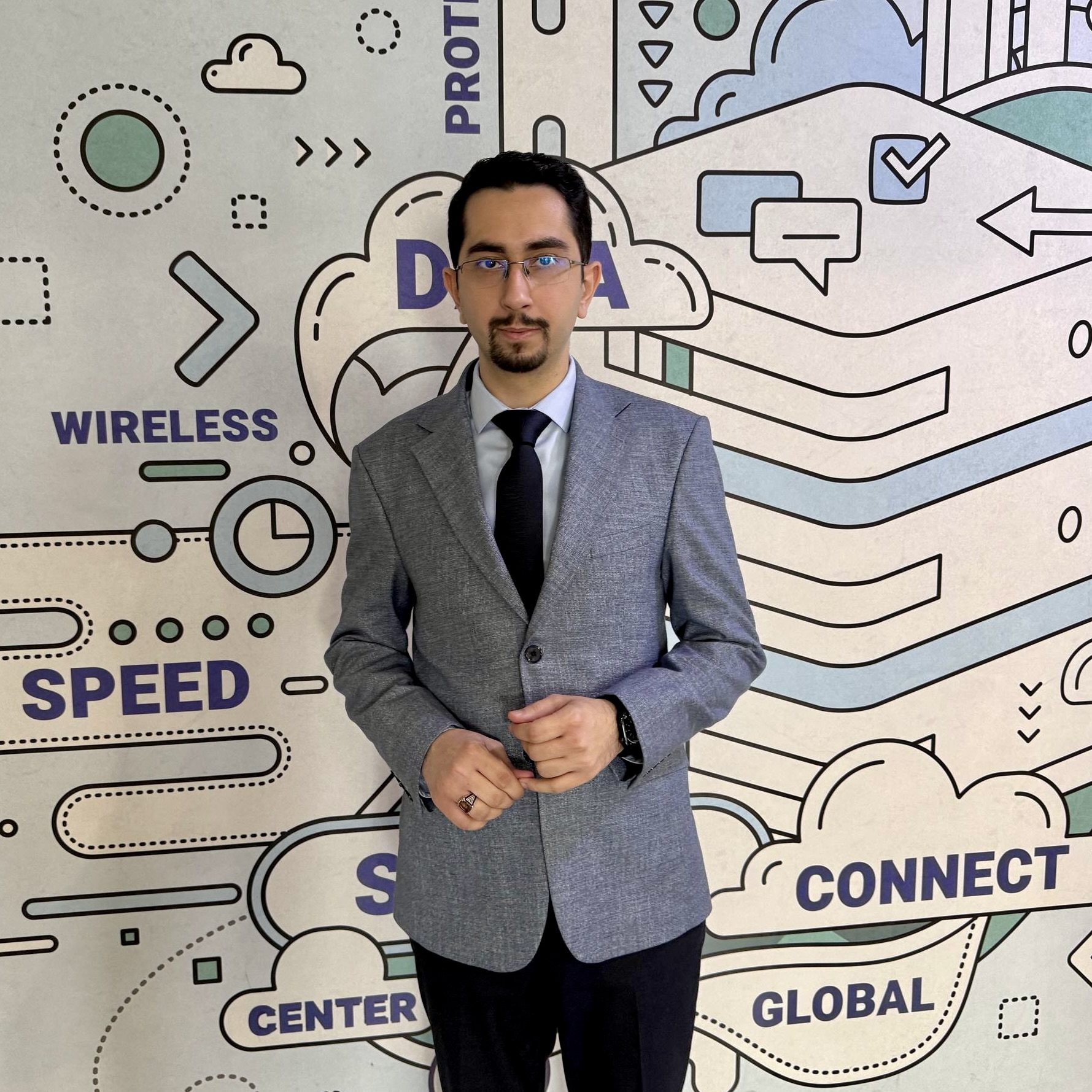
Amir Nejad

Engineering, research & teaching

Amirhossein Shabaninejad (Amir Nejad)

Senior Software Engineer | Distributed Systems | MLOps & Computer Vision

Amirhossein Shabaninejad

Senior Software Engineer with a focus on building reliable, scalable systems in production environments. My work has primarily been around .NET-based services, distributed architectures, and high-throughput financial systems. In parallel, I am developing a research track in MLOps and computer vision, where I focus on designing adaptive inference systems that balance accuracy, latency, and resource usage in real-world conditions. I am particularly interested in problems that sit at the intersection of system design and machine learning, where engineering constraints shape how intelligent systems are built and deployed.

About

An overview of my technical background and areas of research.

I am a backend engineer by training and experience, with a strong focus on building maintainable and scalable systems. My core stack revolves around C#, .NET, and ASP.NET Core, where I rely on clean architecture, domain-driven design (DDD), and CQRS to manage complexity in long-lived systems. I have worked extensively with relational databases such as PostgreSQL and SQL Server in production environments.

Most of my recent work has been in the financial domain, particularly in payment systems where reliability, consistency, and fault tolerance are critical. I have been involved in designing APIs, integrating with external providers, and evolving systems that operate under real-world constraints such as high load, partial failures, and strict availability requirements.

Alongside my industry work, I am pursuing a Master’s degree in Computer Science with a focus on Artificial Intelligence. My research is centered on MLOps and real-time computer vision, specifically exploring how to design systems that can adapt their behavior based on input conditions and system constraints.

Over time, my interests have shifted toward problems that require both solid engineering and analytical thinking—especially where system-level decisions directly impact the behavior of machine learning models. I aim to continue working in this intersection, whether in advanced engineering roles or research-oriented environments.

Projects

Engineering, infrastructure, and thesis research—representative, not exhaustive.

Engineering

Engineering
Domain-Driven Platform Design
Problem: Designing a system that supports dynamic business domains (e.g., categories, attributes, and ads) without requiring frequent schema changes or rigid structures.

Architecture

  • Domain-driven design with clear aggregate boundaries (Business, Ad, Categories).
  • A flexible attribute system allows categories to define their own fields while keeping data consistency within aggregates.

Technologies

  • ASP.NET Core
  • C#
  • PostgreSQL
  • React
  • Docker

Key decisions

  • Focused on keeping the domain model clean and extensible rather than optimizing prematurely for query complexity.
  • Avoided tight coupling between aggregates and kept relationships ID-based to maintain flexibility.
Engineering
Payment System Integrations
Problem: Integrating multiple external financial providers with different protocols, constraints, and reliability characteristics into a unified backend system.

Architecture

  • Service-oriented backend with clear boundaries between core domain logic and external integrations.
  • Use of abstraction layers to isolate provider-specific behavior.

Technologies

  • .NET Core
  • REST/SOAP integrations
  • SQL Server
  • PostgreSQL

Key decisions

  • Prioritized reliability and observability over complexity.
  • Designed integrations to handle partial failures and inconsistencies gracefully rather than assuming ideal conditions.
Engineering
DevOps & Infrastructure Setup
Problem: Establishing a reliable and controllable deployment and CI/CD workflow without relying heavily on managed cloud services.

Architecture

  • Self-hosted GitLab, Docker-based deployments, Nexus repository management, and reverse proxy configuration using Caddy.

Technologies

  • Docker
  • GitLab CI/CD
  • Nexus
  • Linux
  • Caddy

Key decisions

  • Chose open-source and self-managed tools to maintain full control over the environment.
  • Focused on reproducibility, traceability, and simplicity in deployment pipelines.

Research / AI

Research / AI
Adaptive Inference Routing
Problem: Static inference pipelines use a single model for all inputs, which is often inefficient in real-time scenarios with varying input complexity.

Architecture

  • A routing-based system that dynamically decides whether to use a lightweight or more accurate model based on input conditions and predefined signals.

Technologies

  • Python
  • PyTorch
  • Computer Vision libraries

Key decisions

  • Instead of optimizing only for accuracy, the system is designed to balance multiple factors such as latency, computational cost, and confidence.
  • A multi-objective optimization approach is used to explore these trade-offs and define routing policies.
Research / thesis scope—not a commercial product.

Research

Field-level interests and current graduate direction—high level, with detail available in direct correspondence.

Research interests

  • MLOps and production-ready ML systems
  • Real-time computer vision
  • Resource-aware inference
  • Multi-objective optimization

M.Sc. Candidate, Computer Science (AI Focus) — Islamic Azad University (2023–present)

Adaptive Inference and Resource-Aware MLOps for Real-Time Object Detection

My research focuses on designing adaptive inference systems for real-time computer vision. Instead of relying on a single model, the system dynamically decides how to process each input based on its characteristics and system constraints. This approach treats inference as a decision-making problem under constraints such as latency and computational cost.

Key contributions

Routing-Based Inference Design
Framed model selection as a dynamic decision process rather than a fixed pipeline.
Signal-Based Decision Making
Used input-level signals (e.g., confidence and quality proxies) to guide routing decisions.
Multi-Objective Perspective
Evaluated trade-offs between latency, cost, and performance instead of focusing on a single metric.

Emerging results

  • Showed that selective routing can reduce unnecessary computation while maintaining acceptable performance.
  • Provided a framework that connects model-level behavior with system-level constraints.

Papers & preprints

Work is currently being prepared for publication.

Skills

Representative stack and research-adjacent skills—aligned with how I work in production and in graduate study.

Backend & Architecture

  • C#, Python, .NET Core, ASP.NET Core, FastAPI
  • Clean Architecture, DDD, CQRS
  • REST APIs, distributed systems

Data & Storage

  • PostgreSQL, SQL Server
  • Elasticsearch, Redis, MongoDB

DevOps & Infrastructure

  • Docker, CI/CD (GitLab)
  • Linux
  • Reverse proxies (Nginx, Caddy)

AI / Machine Learning

  • Computer Vision fundamentals
  • MLOps concepts and pipelines
  • PyTorch, TensorFlow, Keras
  • Multi-objective optimization

Engineering + Research Philosophy

Why system design and AI research belong in the same conversation.

Building intelligent systems in production is not just a modeling problem—it is a systems problem. Latency, resource limits, failure scenarios, and data quality all influence how models behave in practice. Ignoring these aspects often leads to solutions that work in isolation but fail under real-world conditions.

In my work, I try to make these trade-offs explicit. Instead of relying on a single performance metric, I focus on understanding when a simpler approach is sufficient and when a more complex solution is justified. This applies both to backend systems and to machine learning pipelines.

I am particularly interested in designs where decisions are transparent and measurable. Whether it is routing between services or selecting between models, I prefer approaches that can be reasoned about, evaluated, and improved over time rather than treated as black boxes.

Resume

A brief overview of my professional and academic background. You can download the full resume PDF for more details.

Download PDF

Experience

  • Dec 2024 – Present

    Senior Software Engineer

    Saman Electronic Payment (SEP)

    • Working on backend services in a high-throughput payment environment
    • Contributing to system design improvements and integration with external financial services
    • Involved in maintaining reliability and performance under production constraints
  • Feb 2024 – Nov 2024

    Software Engineer

    Azki

    • Developed and maintained backend services using ASP.NET Core and PostgreSQL
    • Participated in improving system structure and resolving performance bottlenecks
    • Worked closely with product and engineering teams to evolve services over time
  • Earlier (From 2019)

    Backend Developer (Earlier Roles)

    Various Organizations

    • Built backend services across different domains
    • Applied DDD principles where applicable
    • Worked with relational databases and API-based systems

Education

  • 2023 – present

    M.Sc. in Computer Science (AI Focus)

    Islamic Azad University

  • 2017 – 2022

    B.Sc. in Computer Science

    Islamic Azad University

Teaching & outreach

  • Technical Content Creator — YouTube

    Creating educational content on backend engineering and AI fundamentals

    youtube.com/@amir_h_nejad
  • Corporate Training & Mentoring

    Delivering structured sessions on backend architecture and APIs. Mentoring developers on system design concepts.

  • Teaching Assistant — Advanced Databases

    Sep 2023 – Feb 2024

    Islamic Azad University

    Assisted students with database concepts, query optimization, and system design

  • Technical Instructor

    Taught Python backend basics and introductory machine learning concepts

Certifications

  • Docker for Developers
  • Cloud Computing Fundamentals
  • Microservices Design Patterns
  • Software Architecture

Contact

Hiring, collaboration, teaching, or academic conversations—reach out with context.

Direct
Email is the best channel for substantive threads.
Profiles
Code, professional background, and public teaching.